





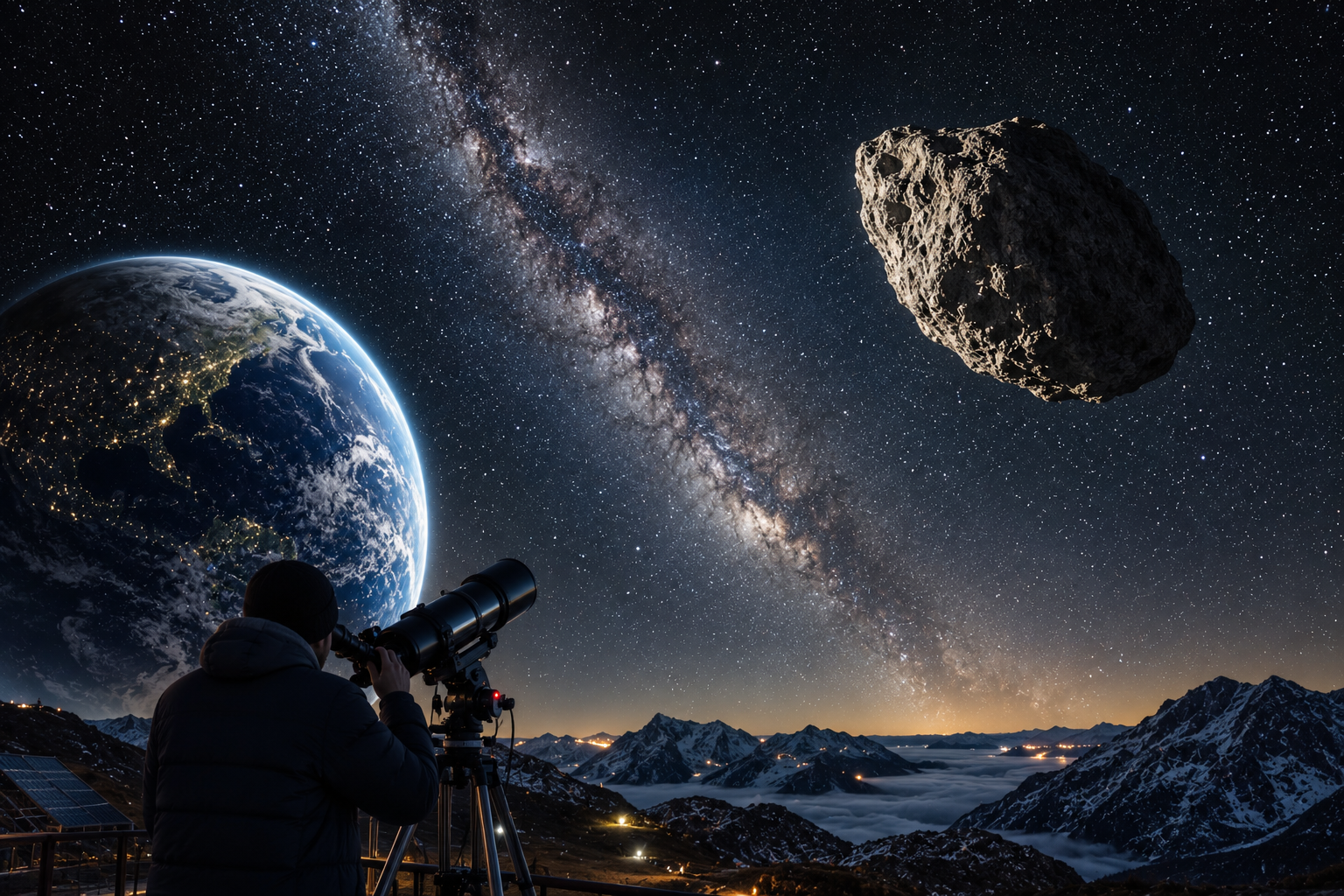
Skywatchers have another exciting reason to look up this weekend. Asteroid 1997 NC1 is making a close approach to Earth, giving astronomy enthusiasts a chance to observe one of our solar system’s many near-Earth objects. While the asteroid will pass at a safe distance, its flyby is an excellent reminder of how active and dynamic our cosmic neighborhood really is.
- What Is Asteroid 1997 NC1?
- Why This Flyby Is Worth Watching: Asteroid 1997 NC1
- Is Asteroid 1997 NC1 Dangerous?
- How Scientists Track Near-Earth Asteroids
- Best Equipment for Observing Asteroid 1997 NC1
- Tips for a Better Viewing Experience
- Why Close Approaches Matter
- What We Learn from Near-Earth Asteroids
- Why Planetary Defense Is Important
- How Amateur Astronomers Contribute
- Final Thoughts
Events like this capture the attention of both professional astronomers and amateur stargazers. Every close approach allows scientists to collect valuable information while giving the public an opportunity to learn more about space. If you have ever wanted to observe an asteroid with your own eyes, or through a telescope, this could be the perfect time to try.
What Is Asteroid 1997 NC1?
Asteroid 1997 NC1 is classified as a near-Earth asteroid, meaning its orbit brings it relatively close to Earth’s orbit around the Sun. Objects in this category are carefully monitored by astronomers around the world to better understand their paths and ensure they do not pose a threat to our planet.
Although the term “close approach” may sound alarming, it simply means the asteroid passes near Earth on an astronomical scale. In reality, these flybys usually occur at distances that remain completely safe.
Scientists continuously update the asteroid’s orbit using observations from ground-based telescopes and space-based instruments.
Why This Flyby Is Worth Watching: Asteroid 1997 NC1
Not every asteroid can be seen with amateur equipment, but some flybys create favorable viewing opportunities.
The approach of Asteroid 1997 NC1 is interesting because it allows observers to watch a real solar system object moving against the background of distant stars. Unlike planets, which change position slowly, an asteroid may appear to drift across the sky during a single observing session.
Watching this motion is one of the most rewarding experiences in amateur astronomy.
Is Asteroid 1997 NC1 Dangerous?
The simple answer is no.
Astronomers have carefully calculated the asteroid’s orbit and confirmed that this flyby does not present an impact risk.
Modern tracking systems monitor thousands of near-Earth objects every year. These systems combine observations from multiple observatories to predict future positions with remarkable accuracy.
When a close approach is announced, it does not mean an impact is expected. Instead, it highlights the importance of continued scientific observation.
How Scientists Track Near-Earth Asteroids
Monitoring objects like Asteroid 1997 NC1 requires teamwork across the global astronomy community.
Researchers use powerful telescopes to record an asteroid’s position over time. Computers then calculate its orbit using repeated observations.
Several factors help improve these calculations:
- Multiple observations over several nights.
- Measurements from different observatories.
- High-precision imaging equipment.
- Advanced orbital models.
As more data becomes available, scientists refine their predictions and improve long-term tracking accuracy.
Best Equipment for Observing Asteroid 1997 NC1
Choosing the right equipment depends on local observing conditions and the asteroid’s brightness.
Binoculars
For brighter astronomical targets, binoculars are an excellent starting point. However, many asteroids remain too faint to see with standard binoculars.
Small Telescope
A telescope with moderate magnification provides a much better chance of detecting faint objects moving through the night sky.
A stable tripod or equatorial mount can make tracking much easier during longer observing sessions.
Star Charts and Astronomy Apps
Digital sky maps help observers locate the correct region of the sky.
Many astronomy apps update object positions automatically, making it easier to identify moving asteroids.
Tips for a Better Viewing Experience
Observing an asteroid requires patience and preparation.
To improve your chances:
- Choose a location away from city lights.
- Check the weather forecast before heading outside.
- Allow your eyes to adjust to the darkness.
- Use a red flashlight to preserve night vision.
- Bring warm clothing if temperatures drop.
Taking your time often makes the experience much more enjoyable.
Why Close Approaches Matter
Every flyby provides scientists with another opportunity to study the solar system.
Researchers may use radar observations, optical imaging, and brightness measurements to learn more about an asteroid’s:
- Size.
- Shape.
- Rotation.
- Surface characteristics.
- Orbital behavior.
These observations improve our understanding of how asteroids formed billions of years ago.
What We Learn from Near-Earth Asteroids
Near-Earth asteroids are often described as ancient leftovers from the formation of the solar system.
Because many have changed very little over billions of years, they preserve clues about conditions that existed before the planets fully formed.
Studying objects like Asteroid 1997 NC1 helps scientists investigate:
- The history of the solar system.
- Planet formation.
- The composition of primitive rocky bodies.
- Future planetary defense strategies.
Each new observation contributes to a larger scientific picture.
Why Planetary Defense Is Important
Although Asteroid 1997 NC1 poses no threat, monitoring near-Earth objects remains an important scientific responsibility.
Space agencies around the world continue improving detection systems capable of identifying potentially hazardous asteroids many years before any possible close approach.
Early detection provides valuable time to study an object’s orbit and, if ever necessary, develop methods to alter its path.
Fortunately, the overwhelming majority of monitored asteroids never present a danger to Earth.
How Amateur Astronomers Contribute
Professional observatories are not the only contributors to asteroid research.
Experienced amateur astronomers frequently submit observations that help improve orbital calculations.
Their work supports international databases used by researchers worldwide.
This collaboration between professionals and hobbyists demonstrates how astronomy remains one of the most accessible sciences for public participation.
Final Thoughts
The flyby of Asteroid 1997 NC1 offers an exciting opportunity to connect with the night sky and learn more about our place in the solar system. While the asteroid will safely pass Earth, its journey reminds us that countless rocky objects travel through our cosmic neighborhood every day.
Whether you observe the event through a telescope or simply use it as inspiration to learn more about astronomy, close approaches like this highlight the incredible work being done by scientists to monitor our solar system.
If you’re interested in space exploration and celestial events, keep watching for future asteroid flybys. Each one provides another chance to witness the dynamic nature of our universe and appreciate the science that keeps us informed about the skies above.
Read Other Interesting news here: Super Puff Planets

