

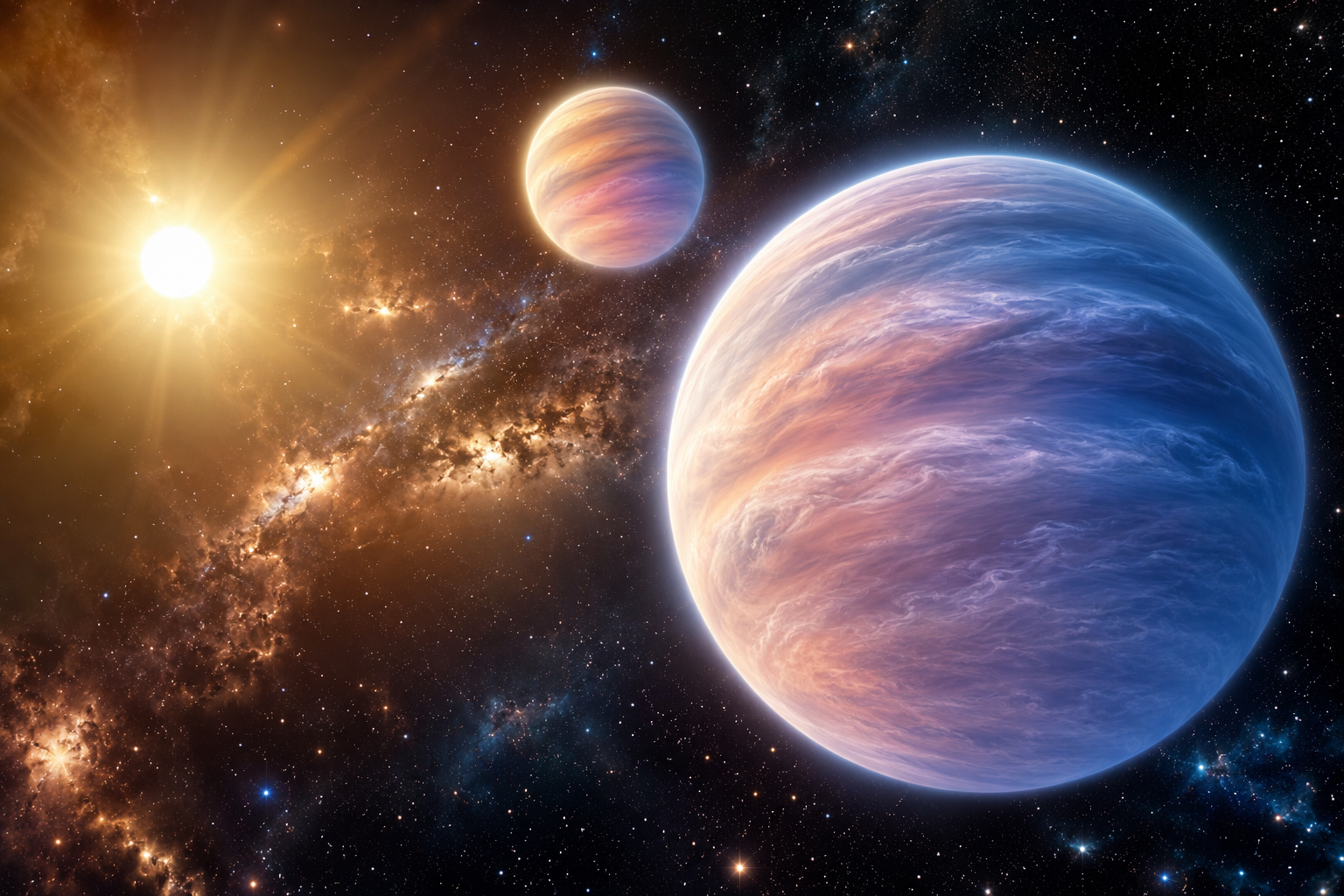
When most people imagine giant planets, they think of massive worlds packed with thick layers of gas and powerful gravity. However, astronomers have discovered a rare class of planets that challenge everything we know about planetary formation. These fascinating worlds are known as Super Puff Planets, and they are so light for their enormous size that they have earned comparisons to cotton candy.
- What Are Super Puff Planets?
- Why These Planets Are So Extraordinary: Super Puff Planets
- A Rare Planetary Family
- An Unusual Orbital Relationship
- How Astronomers Found These Worlds
- The Power of International Collaboration
- Why Antarctica Is Valuable for Astronomy
- How Super Puff Planets May Form
- The Role of Next-Generation Space Telescopes
- Why This Discovery Matters
- What the Future Holds
- Final Thoughts
The recent discovery of an unusual pair of these planets has given scientists a rare opportunity to study how such extraordinary worlds form and survive. Although both planets are about the size of Jupiter, they contain far less material than expected, making them some of the least dense planets ever confirmed.
Because Super Puff Planets are incredibly rare, every new discovery helps researchers better understand how planetary systems evolve throughout our galaxy.
What Are Super Puff Planets?
Super Puff Planets are giant exoplanets with extremely low densities. While they may appear as large as Jupiter when viewed during a planetary transit, they contain much less mass than typical gas giants.
This combination of a large size and surprisingly low mass gives these planets their unique “puffy” appearance.
Scientists believe their enormous atmospheres contain large amounts of lightweight gases, making them expand far beyond what would normally be expected.
Unlike rocky planets such as Earth, these distant worlds are dominated by thick gaseous envelopes.
Why These Planets Are So Extraordinary: Super Puff Planets
The newly studied planetary system attracted worldwide attention because it contains two Super Puff Planets orbiting the same star.
Finding one super-puff planet is already uncommon. Discovering two within a single planetary system gives astronomers an excellent opportunity to compare their properties and better understand how similar planets develop.
Researchers found that both planets have densities far below those of most known gas giants.
This remarkable characteristic makes them among the lightest planets ever measured for their size.
A Rare Planetary Family
Scientists believe the two planets likely formed from the same cloud of gas and dust surrounding their young star.
Because they developed together, researchers often describe them as planetary siblings.
Studying sibling planets is especially valuable because both worlds experienced similar conditions during their formation. This allows astronomers to compare how slight differences in mass, distance, and atmospheric evolution can produce unique results.
The discovery also highlights how diverse planetary systems can be across our galaxy.
An Unusual Orbital Relationship
One reason astronomers find this system so exciting is the way the two planets move around their host star.
Their orbits are linked through a stable gravitational relationship known as orbital resonance.
As the planets travel around their star, they repeatedly influence each other’s motion through gravity.
These tiny interactions create measurable changes in the timing of planetary transits.
Scientists carefully analyze these timing variations because they reveal important information about each planet’s mass and orbital behavior.
Without these gravitational clues, measuring such lightweight planets would be much more difficult.
How Astronomers Found These Worlds
Discovering distant exoplanets requires years of careful observation.
One of the most successful techniques is the transit method.
When a planet passes in front of its host star, it blocks a very small amount of the star’s light.
Sensitive instruments detect this tiny dip in brightness.
By repeating these observations over many years, astronomers can determine:
- The planet’s size.
- Its orbital period.
- The distance from its star.
- Possible interactions with neighboring planets.
Combining observations from multiple telescopes allows researchers to estimate both the planet’s size and its mass, making density calculations possible.
The Power of International Collaboration
Modern astronomy depends on cooperation between scientists around the world.
Large discoveries rarely come from a single telescope.
Instead, researchers combine information collected by observatories located in different countries and even on different continents.
Space telescopes monitor stars from orbit, while ground-based observatories provide additional measurements that improve accuracy.
Long-term collaboration allows scientists to confirm discoveries that would otherwise remain uncertain.
This teamwork continues to play a major role in expanding our knowledge of Super Puff Planets.
Why Antarctica Is Valuable for Astronomy
Some astronomical observations require continuous monitoring for many hours.
Locations near Earth’s poles offer unique advantages because winter nights can last for months.
These long periods of darkness allow telescopes to observe planetary transits without interruptions caused by sunrise.
For planets with especially long transit times, uninterrupted observations greatly improve measurement accuracy.
Remote observatories therefore remain important partners in international astronomy projects.
How Super Puff Planets May Form
Scientists are still investigating exactly how Super Puff Planets develop.
Several ideas continue to be explored.
One possibility is that these planets formed farther away from their stars, where colder temperatures allowed them to collect enormous amounts of hydrogen and helium before migrating inward.
Another idea suggests that unusually extended atmospheres remained stable over long periods, giving the planets their inflated appearance.
Researchers continue comparing computer models with new observations to determine which explanation best matches reality.
Future discoveries may reveal that more than one formation process is responsible.
The Role of Next-Generation Space Telescopes
New telescopes are opening exciting opportunities to study distant planets in greater detail.
Instead of only measuring planetary size, astronomers can now investigate atmospheric composition.
Future observations may help identify gases such as:
- Water vapor.
- Carbon-bearing molecules.
- Nitrogen compounds.
- Oxygen-containing chemicals.
Studying atmospheric chemistry helps scientists reconstruct how planets formed and evolved over billions of years.
These observations also improve our understanding of planetary diversity throughout the Milky Way.
Why This Discovery Matters
Although Super Puff Planets are unlikely to support life as we know it, they remain incredibly important for planetary science.
Every unusual world challenges existing theories and encourages scientists to improve their models.
Understanding how giant planets form also helps researchers explain the history of our own solar system.
The more astronomers learn about distant planetary systems, the better they understand the processes that shaped Jupiter, Saturn, Uranus, and Neptune.
Rare discoveries often lead to the biggest scientific breakthroughs.
What the Future Holds
Astronomy continues advancing at an incredible pace.
Improved telescopes, more powerful computers, and international cooperation are making it easier than ever to detect new worlds.
Scientists expect thousands of additional exoplanets to be discovered over the coming years.
Among them may be many more Super Puff Planets, each providing valuable clues about how planets evolve under different conditions.
As technology improves, researchers will be able to study these distant worlds in greater detail than ever before.
Final Thoughts
The discovery of additional Super Puff Planets reminds us that the universe is far more diverse than scientists once imagined. Giant planets can exist in forms that seem almost impossible, challenging long-standing ideas about planetary formation and atmospheric evolution.
By combining observations from space missions and ground-based observatories, astronomers continue uncovering remarkable worlds that expand our understanding of the cosmos. Future research will reveal even more about these mysterious planets and may answer one of astronomy’s biggest questions: how do such enormous yet incredibly lightweight worlds come into existence?
If you enjoy following discoveries beyond our solar system, keep an eye on future exoplanet research. Every new observation brings us closer to understanding the incredible variety of planets that exist throughout our galaxy.
Read Other Interesting news here: NASA Space Partnerships