

Black Hole Gravitational Waves are changing the way scientists understand the universe. For many years, black holes remained one of astronomy’s greatest mysteries because they cannot be observed directly. Today, thanks to advanced gravitational wave detectors, researchers can study these invisible cosmic giants in ways that were impossible just a decade ago.
- What Are Black Holes?
- Understanding Black Hole Gravitational Waves
- The Event Horizon: The Point of No Escape
- Why Scientists Study Black Hole Mergers
- How Scientists Detect Black Hole Gravitational Waves
- Testing Einstein’s Greatest Theory
- Why Stronger Gravitational Waves Matter
- The Future of Black Hole Research
- How This Research Benefits Humanity
- Why Black Hole Gravitational Waves Fascinate the Public
- Final Thoughts
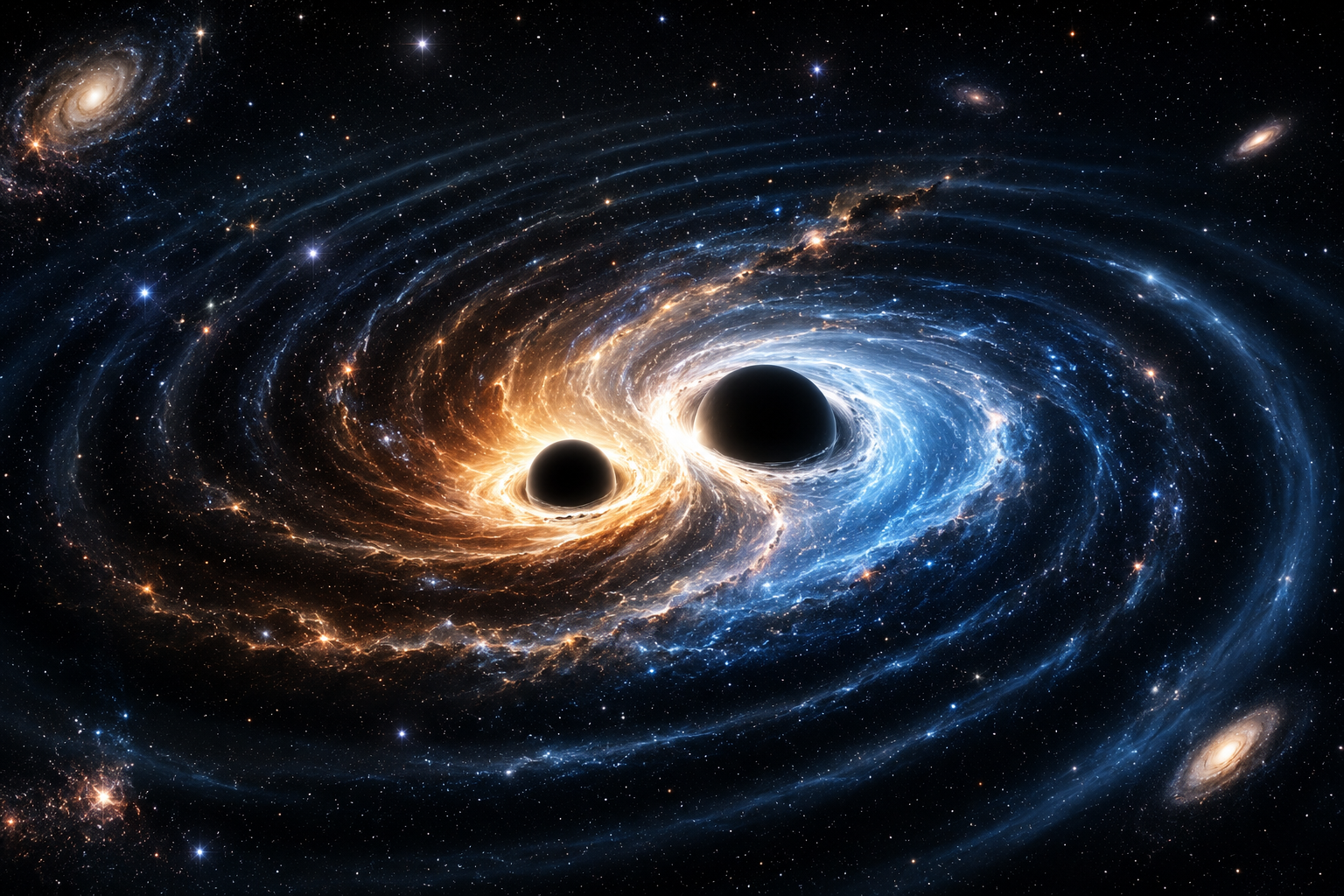
Every time two black holes collide, they send powerful ripples through space and time. These ripples, known as gravitational waves, carry valuable information about the collision and the newly formed black hole. By analyzing these signals, scientists can investigate the mysterious boundary called the event horizon, often described as the point of no escape.
As technology continues to improve, Black Hole Gravitational Waves are opening an entirely new window into the universe and helping researchers test some of the biggest ideas in modern physics.
What Are Black Holes?
Black holes are regions in space where gravity is so strong that nothing can escape once it crosses the event horizon—not even light.
Most black holes form after massive stars reach the end of their lives and collapse under their own gravity. Others become much larger over time by absorbing nearby matter or merging with other black holes.
Although they cannot be seen directly, scientists know they exist because of their effects on nearby stars, gas clouds, and gravitational waves.
Some fascinating facts about black holes include:
- Their gravity bends space and time.
- They can contain several times the mass of our Sun.
- Some supermassive black holes are millions or even billions of times more massive than the Sun.
- They can merge with other black holes, creating powerful gravitational waves.
Understanding Black Hole Gravitational Waves
Black Hole Gravitational Waves are tiny ripples that travel through space after massive cosmic events.
More than one hundred years ago, Albert Einstein predicted these waves in his theory of General Relativity. At the time, scientists believed detecting them would be nearly impossible.
That changed in 2015 when gravitational waves were directly observed for the first time. Since then, researchers have detected many more signals from black hole mergers.
Each detection gives astronomers another opportunity to learn about gravity under the most extreme conditions found anywhere in the universe.
How Do Gravitational Waves Form?
When two black holes orbit one another, they slowly lose energy.
As they move closer together, they begin spinning faster and faster. Eventually, they collide in a violent merger that releases an enormous amount of energy.
Instead of producing visible light, the collision sends Black Hole Gravitational Waves across the universe at the speed of light.
These waves continue traveling through space until they reach Earth, where highly sensitive observatories can detect them.
The Event Horizon: The Point of No Escape
One of the most mysterious parts of every black hole is its event horizon.
The event horizon forms an invisible boundary surrounding the black hole.
Once any object crosses this boundary, escape becomes impossible because gravity becomes overwhelmingly powerful.
Scientists cannot photograph the event horizon directly during every merger, but Black Hole Gravitational Waves provide valuable clues about how this boundary behaves during the final stages of a collision.
Studying these signals helps researchers understand whether black holes behave exactly as predicted by Einstein’s equations.
Why Scientists Study Black Hole Mergers
Black hole mergers are among the most energetic events ever observed.
During a merger, enormous amounts of energy are released within a fraction of a second.
Although the collision produces no visible explosion, the resulting gravitational waves travel across billions of light-years carrying detailed information about the event.
Researchers analyze these signals to determine:
- The masses of both black holes.
- Their spin before the collision.
- Their orbital motion.
- The size of the newly formed black hole.
- Whether Einstein’s theory accurately predicts the outcome.
Every new observation makes Black Hole Gravitational Waves even more valuable for understanding the universe.
How Scientists Detect Black Hole Gravitational Waves
Unlike traditional telescopes, gravitational wave observatories do not rely on light.
Instead, they use extremely precise laser systems capable of detecting incredibly small distortions in space-time.
When Black Hole Gravitational Waves pass through Earth, they stretch and compress space by distances much smaller than an atom.
To measure these tiny changes, scientists use long vacuum tunnels equipped with mirrors and laser beams.
The basic process includes:
- A laser beam is divided into two paths.
- The beams travel through long vacuum tubes.
- Mirrors reflect the beams back.
- The returning light is compared.
- Even the smallest change reveals the passing gravitational wave.
This remarkable technology has completely transformed modern astronomy.
Testing Einstein’s Greatest Theory
One of the biggest goals of studying Black Hole Gravitational Waves is testing Einstein’s theory of General Relativity.
Gravity behaves very differently near black holes than it does on Earth.
Because of these extreme conditions, black hole mergers provide the perfect laboratory for testing the laws of physics.
So far, observations have continued to support Einstein’s predictions.
However, scientists remain hopeful that future observations could reveal tiny differences that point toward entirely new physics beyond our current understanding.
Why Stronger Gravitational Waves Matter
Not every gravitational wave carries the same amount of information.
Some signals are relatively weak, while others are exceptionally strong.
The strongest signals allow researchers to study black holes with much greater precision.
Stronger Black Hole Gravitational Waves help scientists:
- Improve measurements.
- Better estimate black hole masses.
- Study the event horizon.
- Understand how black holes spin.
- Refine computer simulations.
- Search for unexpected physical behavior.
Each powerful signal adds another important piece to the puzzle of our universe.
The Future of Black Hole Research
Astronomy is entering an exciting new era.
Scientists continue improving gravitational wave observatories to detect weaker and more distant signals.
Future space-based observatories are expected to detect entirely new types of gravitational waves that cannot be observed from Earth.
These future missions may help researchers:
- Detect thousands of black hole mergers every year.
- Study supermassive black holes.
- Observe the earliest galaxies.
- Learn more about dark matter.
- Better understand the evolution of the universe.
As these instruments become more advanced, Black Hole Gravitational Waves will continue revealing hidden parts of the cosmos.
How This Research Benefits Humanity
Although black hole research focuses on distant objects, its impact reaches far beyond astronomy.
Developing ultra-sensitive instruments has driven advances in several fields, including:
- Laser engineering.
- Precision measurement.
- Artificial intelligence.
- Big data analysis.
- High-performance computing.
Many technologies originally developed for space science later become useful in medicine, communications, manufacturing, and engineering.
This makes investments in astronomy valuable not only for scientific discovery but also for technological innovation.
Why Black Hole Gravitational Waves Fascinate the Public
Black holes have always captured people’s imagination.
They challenge our understanding of reality, space, and time.
Now, instead of relying only on mathematical theories, scientists can actually “listen” to the universe through Black Hole Gravitational Waves.
Every new detection tells a story that happened millions or even billions of years ago.
These discoveries remind us how vast the universe truly is and how much remains to be explored.
As more observations are made, researchers expect to uncover even greater cosmic mysteries.
Final Thoughts
Black Hole Gravitational Waves have transformed modern astronomy by giving scientists an entirely new way to explore the universe. Instead of depending only on telescopes that detect light, researchers can now study the invisible collisions of black holes through the ripples they create in space-time.
Every new detection improves our understanding of black holes, the mysterious event horizon, and the laws that govern the cosmos. These discoveries continue to confirm important ideas about gravity while also leaving room for exciting future breakthroughs.
As technology becomes even more advanced, Black Hole Gravitational Waves will remain one of the most powerful tools for exploring the deepest mysteries of the universe. The coming years are likely to bring even more discoveries that could reshape our understanding of space, time, and the nature of reality itself.
Whether you are an astronomy enthusiast or simply curious about the universe, following the latest research into Black Hole Gravitational Waves is an exciting way to witness science pushing the boundaries of human knowledge.
Read Other Interesting news here: SpeedNewsCentral Review