

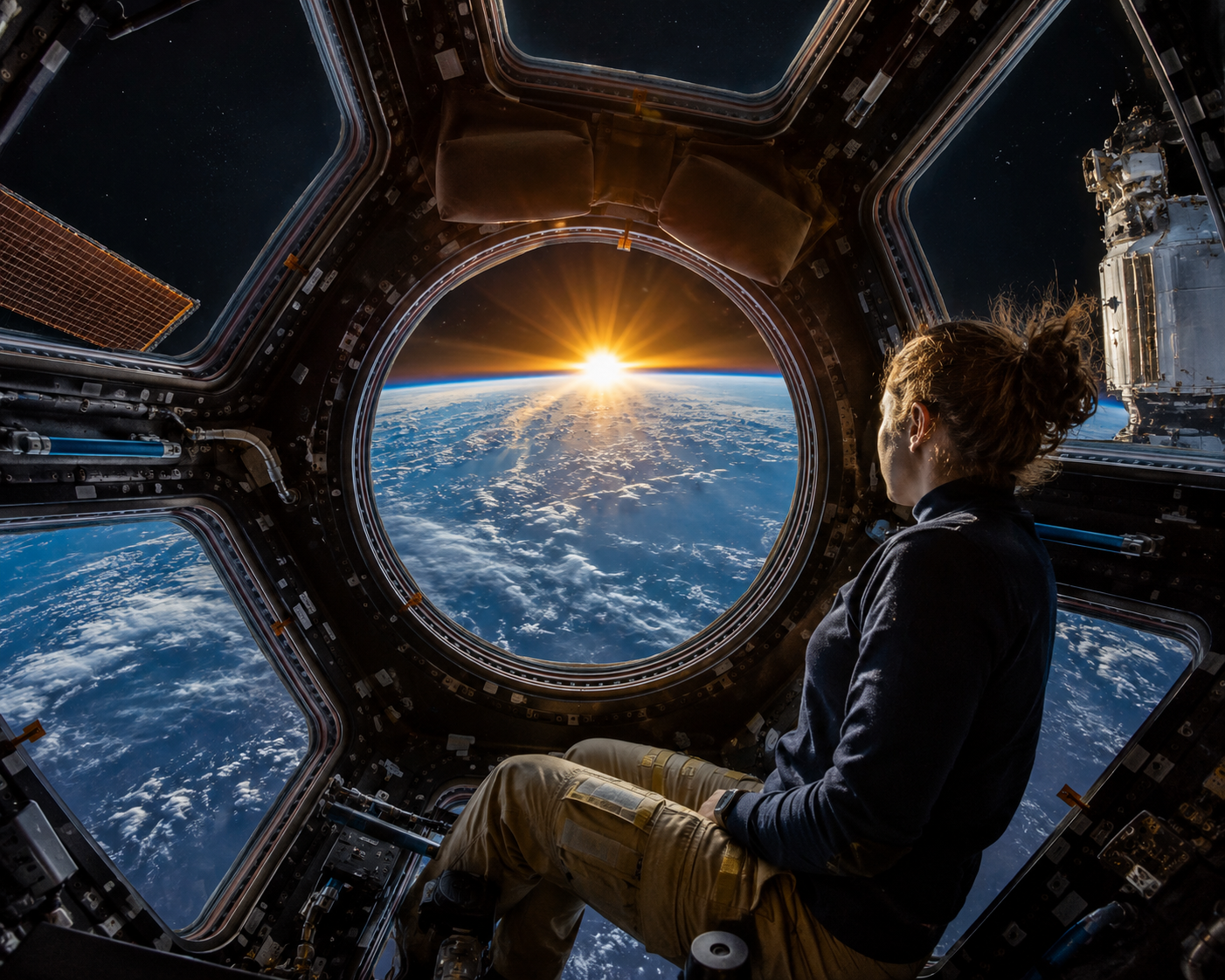
Imagine starting your morning by watching the Sun rise over Earth—then seeing it set less than an hour later. On the ISS Sunrises, this isn’t science fiction. It’s simply part of everyday life.
- Why Astronauts See So Many Sunrises: ISS Sunrises
- How Fast Is the International Space Station?: ISS Sunrises
- What Does Sunrise Look Like From Space?: ISS Sunrises
- Why the ISS Doesn’t Use Sunrise as a Clock: ISS Sunrises
- How Astronauts Protect Their Sleep: ISS Sunrises
- Life Aboard the International Space Station: ISS Sunrises
- Why the ISS Travels So Quickly: ISS Sunrises
- The Science Behind Low Earth Orbit: ISS Sunrises
- Why This Perspective Matters: ISS Sunrises
- How the ISS Supports Future Exploration: ISS Sunrises
- Final Thoughts
One of the most fascinating aspects of living aboard the ISS is the incredible number of sunrises astronauts experience. Instead of waking up to one sunrise each day, the station’s rapid orbit around Earth allows its crew to witness approximately 16 sunrises and 16 sunsets every 24 hours.
This remarkable phenomenon is a direct result of orbital mechanics and offers a glimpse into just how different life becomes once humans leave Earth’s surface.
Why Astronauts See So Many Sunrises: ISS Sunrises
The ISS circles Earth at an extraordinary speed.
Traveling at roughly 7.66 kilometers per second (about 5 miles per second), the station completes one orbit in approximately 90 minutes.
Because each orbit carries the station through Earth’s illuminated side and then its shadow, astronauts repeatedly move from daylight into darkness and back again.
Over a full day, this rapid cycle produces around 16 daylight periods and 16 nighttime periods.
How Fast Is the International Space Station?: ISS Sunrises
The ISS moves fast enough to circle our planet about 16 times each day.
At this speed, the station covers thousands of kilometers every hour while remaining in low Earth orbit.
This incredible velocity is necessary because the station is constantly falling toward Earth while simultaneously moving forward fast enough to keep missing it. That balance creates a stable orbit instead of allowing the spacecraft to crash back to Earth.
What Does Sunrise Look Like From Space?: ISS Sunrises
Watching sunrise from orbit is very different from experiencing it on the ground.
Instead of a slow transition lasting many minutes, astronauts often see sunlight spread across Earth’s horizon in less than a minute.
The planet’s thin atmosphere creates brilliant layers of blue, orange, and gold before the Sun suddenly appears above the curved horizon.
Many astronauts describe these moments as among the most beautiful sights they experience during a mission.
Why the ISS Doesn’t Use Sunrise as a Clock: ISS Sunrises
On Earth, people naturally associate sunrise with morning and sunset with evening.
That approach simply doesn’t work aboard the ISS.
With daylight changing every 45 to 50 minutes, astronauts rely on Coordinated Universal Time (UTC) instead of local sunlight.
Using one standard time helps synchronize operations between astronauts, mission control teams, and international partners.
A carefully planned schedule determines:
- Wake-up time
- Scientific experiments
- Exercise sessions
- Meals
- Communication periods
- Sleep
Following UTC keeps daily activities consistent despite the constantly changing view outside the station.
How Astronauts Protect Their Sleep: ISS Sunrises
Living in space presents unique challenges for the human body.
Frequent daylight changes can disrupt the body’s natural internal clock, known as the circadian rhythm.
To reduce these effects, astronauts follow structured schedules rather than relying on natural sunlight.
Modern lighting systems inside the station can also change brightness and color throughout the day.
Cooler, brighter light helps promote alertness, while warmer lighting supports relaxation before bedtime.
These systems help create a more Earth-like daily routine inside the station.
Life Aboard the International Space Station: ISS Sunrises
Although the sunrise schedule is extraordinary, astronauts spend most of their time conducting scientific research and maintaining the station.
A typical day may include:
- Scientific experiments
- Equipment maintenance
- Earth observation
- Medical research
- Daily exercise
- Educational outreach
Crew members also spend time photographing Earth, one of the most popular activities during off-duty hours.
Why the ISS Travels So Quickly: ISS Sunrises
Many people wonder why the station must move so fast.
The answer lies in gravity.
Earth’s gravity continuously pulls the ISS downward. However, the station’s tremendous forward speed causes it to keep falling around Earth rather than directly toward it.
This constant free-fall creates the sensation of weightlessness experienced by astronauts.
Without its orbital speed, the ISS would quickly re-enter Earth’s atmosphere.
The Science Behind Low Earth Orbit: ISS Sunrises
The ISS operates in low Earth orbit, hundreds of kilometers above the planet’s surface.
At this altitude, Earth’s atmosphere becomes extremely thin but is not completely absent.
Tiny amounts of atmospheric drag gradually slow the station over time.
To maintain its orbit, visiting spacecraft periodically perform small engine burns that gently raise the station back to its desired altitude.
These adjustments help ensure the ISS remains a stable laboratory for scientific research.
Why This Perspective Matters: ISS Sunrises
Astronauts frequently say that seeing Earth from orbit changes how they think about the planet.
From space, national borders disappear.
Instead, crew members see one connected world covered by oceans, continents, clouds, and thin atmospheric layers that support all known life.
Many astronauts describe this experience as inspiring a greater appreciation for environmental protection and international cooperation.
The repeated cycles of sunrise and sunset reinforce how dynamic our planet truly is.
How the ISS Supports Future Exploration: ISS Sunrises
The International Space Station is much more than an orbiting laboratory.
It serves as a testing ground for technologies that may one day support missions to the Moon and Mars.
Scientists study:
- Human health in microgravity
- Advanced robotics
- Space agriculture
- Water recycling
- Life-support systems
- Radiation effects
Every experiment helps prepare future explorers for longer journeys deeper into space.
Final Thoughts
The experience of seeing ISS Sunrises 16 times every day perfectly illustrates how different life becomes in orbit. Traveling around Earth every 90 minutes transforms ordinary events like sunrise and sunset into frequent reminders of the station’s incredible speed and unique environment.
Beyond the spectacular views, the ISS continues to play a vital role in advancing science, improving our understanding of life in space, and preparing humanity for future exploration beyond low Earth orbit.
Whether you are passionate about astronomy or simply curious about life aboard the International Space Station, the daily rhythm of repeated sunrises offers one of the clearest examples of how extraordinary human spaceflight has become.
Read Other Interesting news here: Voyager 1 Milestone