

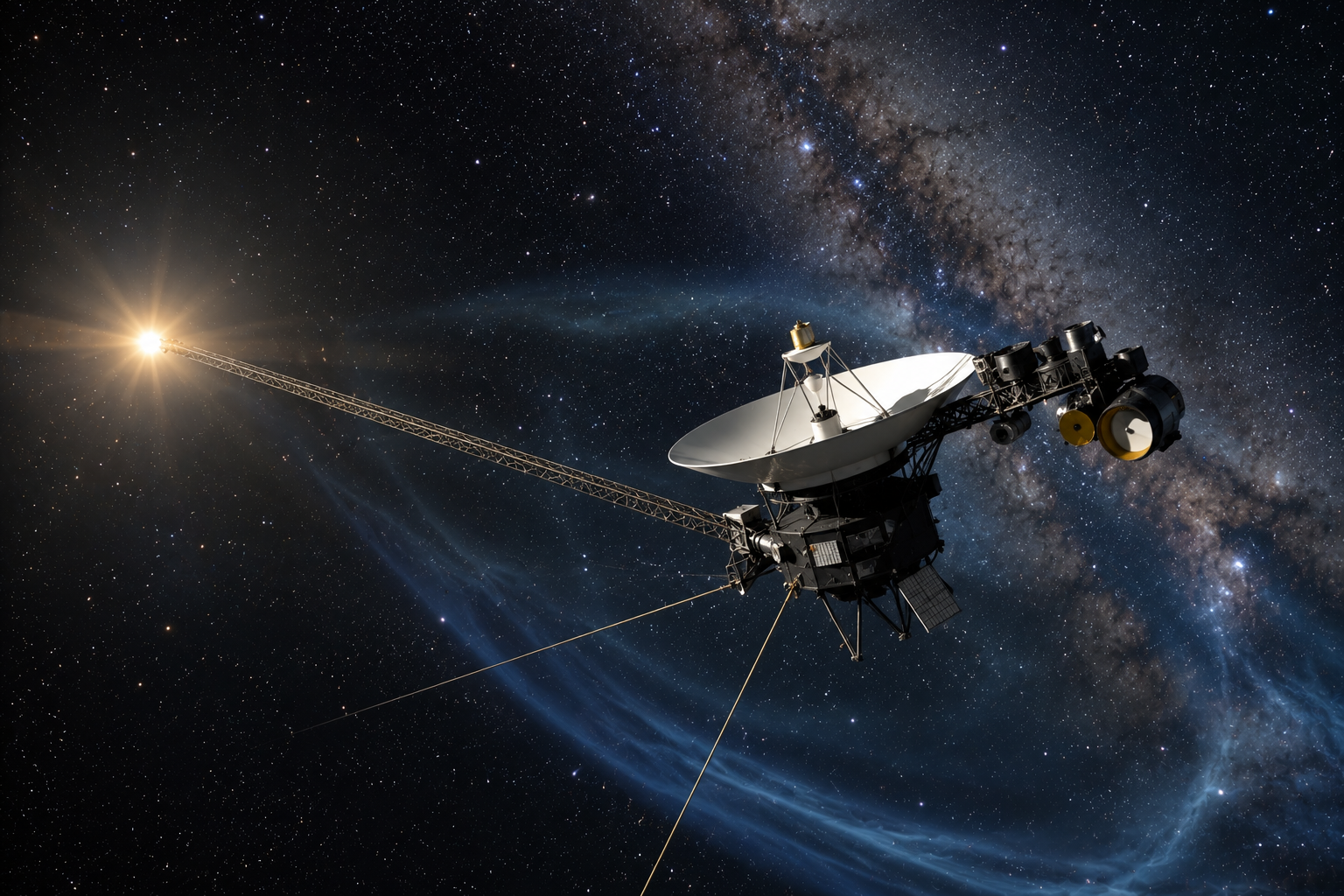
For nearly five decades, Voyager 1 Milestone moments have inspired scientists, students, and space enthusiasts around the world. Launched in 1977, the spacecraft has traveled farther than any other human-made object and continues to send valuable scientific information from the edge of our cosmic neighborhood.
- What Does One Light-Day Mean?
- The Story Behind Voyager 1: Voyager 1 Milestone
- Entering Interstellar Space: Voyager 1 Milestone
- Why This Milestone Matters: Voyager 1 Milestone
- How Voyager 1 Still Communicates: Voyager 1 Milestone
- Conserving Power for the Future: Voyager 1 Milestone
- Voyager 1 vs. Voyager 2: Voyager 1 Milestone
- The Golden Record: Humanity’s Message to the Cosmos: Voyager 1 Milestone
- Lessons From Voyager’s Success: Voyager 1 Milestone
- The Future of Deep-Space Exploration: Voyager 1 Milestone
- Why Voyager Still Inspires the World
- Final Thoughts
Another remarkable chapter is approaching as Voyager 1 reaches the incredible distance of one light-day from Earth. This achievement is more than just a number. It highlights the extraordinary engineering behind one of the most successful space missions ever launched and reminds us how far human curiosity can reach.
Even after decades in space, Voyager 1 continues to demonstrate the lasting value of scientific exploration.
What Does One Light-Day Mean?
The phrase one light-day describes the distance that light travels in 24 hours.
Because light moves at roughly 299,792 kilometers per second (186,282 miles per second), this distance is enormous. When Voyager 1 reaches this point, radio signals traveling at the speed of light require approximately one full day to travel one way between Earth and the spacecraft.
That means engineers must wait about two days for a command to be sent and a response to return.
This communication delay highlights just how far Voyager 1 has traveled since leaving Earth.
The Story Behind Voyager 1: Voyager 1 Milestone
Voyager 1 launched during an exciting period in space exploration.
Its original mission focused on exploring the outer planets of our solar system. During its early years, the spacecraft captured detailed observations of Jupiter and Saturn, transforming scientists’ understanding of these giant worlds.
Among its achievements were:
- Detailed images of Jupiter’s cloud systems.
- New information about Saturn’s rings.
- Discoveries involving several planetary moons.
- Measurements of magnetic fields and charged particles.
Although the primary mission eventually ended, Voyager 1’s journey was far from over.
Entering Interstellar Space: Voyager 1 Milestone
One of Voyager 1’s greatest achievements came when it crossed the outer boundary of the Sun’s protective influence and entered interstellar space.
This region is not empty. Instead, it contains thin clouds of gas, energetic particles, and magnetic fields that exist between the stars of our galaxy.
Studying this environment helps scientists better understand how our solar system interacts with the wider Milky Way.
Voyager 1 remains the only spacecraft actively returning information from this distant region.
Why This Milestone Matters: Voyager 1 Milestone
The Voyager 1 Milestone represents much more than distance alone.
It demonstrates the remarkable durability of space technology designed nearly fifty years ago. Few machines ever built have operated successfully for such a long period under the harsh conditions of deep space.
This achievement also reminds us that scientific missions often continue producing valuable discoveries long after their original goals have been completed.
Every signal received from Voyager 1 contributes to humanity’s understanding of our place in the universe.
How Voyager 1 Still Communicates: Voyager 1 Milestone
Communicating across billions of kilometers is an extraordinary engineering challenge.
Powerful radio antennas on Earth send carefully timed commands toward the spacecraft. Voyager 1 receives those instructions using its onboard communication system and transmits scientific data back through the Deep Space Network.
Because the spacecraft is so distant, every message requires careful planning.
Engineers cannot control Voyager in real time. Instead, they must anticipate conditions well in advance and patiently wait for each response.
Conserving Power for the Future: Voyager 1 Milestone
Voyager 1 relies on a radioisotope power system that slowly produces less electricity over time.
To keep the spacecraft operating as long as possible, mission engineers have gradually turned off non-essential systems.
This careful power management allows the remaining scientific instruments to continue collecting valuable information.
Each additional year of operation extends one of the longest-running scientific missions in history.
Voyager 1 vs. Voyager 2: Voyager 1 Milestone
Although both Voyager spacecraft launched during the same mission era, their journeys have been very different.
Voyager 1 focused primarily on Jupiter and Saturn before heading toward interstellar space.
Voyager 2 followed a longer route that included close encounters with Uranus and Neptune, making it the only spacecraft ever to visit those distant planets.
Today, both spacecraft continue traveling away from the Sun, although they are moving in different directions through space.
Together, they provide scientists with valuable information about regions that no other spacecraft have explored.
The Golden Record: Humanity’s Message to the Cosmos: Voyager 1 Milestone
One of the most famous features of the Voyager mission is the Golden Record.
Attached to each spacecraft is a gold-plated phonograph record containing sounds, music, greetings, and images selected to represent life and culture on Earth.
The record includes:
- Greetings in multiple languages.
- Natural sounds from Earth.
- Music from different cultures.
- Images of humanity and nature.
Although it is unlikely to be discovered anytime soon, the Golden Record symbolizes humanity’s hope of sharing its story with the universe.
Lessons From Voyager’s Success: Voyager 1 Milestone
The Voyager program has taught scientists important lessons that continue influencing modern space exploration.
Some of its lasting contributions include:
- Long-duration spacecraft engineering.
- Deep-space communication techniques.
- Planetary exploration strategies.
- International scientific cooperation.
- Mission planning for future interstellar probes.
Modern missions continue building upon the experience gained through Voyager.
The Future of Deep-Space Exploration: Voyager 1 Milestone
Voyager 1’s journey demonstrates what can be achieved through patience, innovation, and scientific curiosity.
Future missions may travel even farther using advanced propulsion systems, improved communication technology, and more sophisticated scientific instruments.
Scientists also hope future spacecraft will investigate the boundary between our solar system and interstellar space in greater detail.
The knowledge gained from Voyager provides an important foundation for those future explorers.
Why Voyager Still Inspires the World
Few scientific missions have captured the public imagination like Voyager.
Its incredible journey reminds us that exploration is not limited to a single generation. A spacecraft launched decades ago continues expanding humanity’s understanding of the universe today.
Students, engineers, astronomers, and dreamers all see Voyager as a symbol of curiosity and perseverance.
Every new milestone encourages future generations to keep exploring beyond the limits of what seems possible.
Final Thoughts
The Voyager 1 Milestone of reaching one light-day from Earth is another remarkable achievement in one of humanity’s greatest scientific adventures. Decades after its launch, the spacecraft continues traveling through interstellar space while sending valuable information back to Earth.
Its success reflects the dedication of thousands of scientists and engineers who designed a mission capable of lasting far beyond its original objectives. As Voyager 1 continues its silent journey among the stars, it serves as a lasting reminder that exploration has no true finish line.
Whether you are passionate about astronomy or simply fascinated by humanity’s achievements, Voyager 1 offers an inspiring example of how curiosity can carry us farther than we ever imagined.
Read Other Interesting news here: Asteroid 1997 NC1